At the beginning of the 20th century, Bitola stood as one of the most important administrative, military, and cultural centers of the Ottoman Empire. Known as “the City of Consuls,” it was a crossroads of interests, ideas, and influences — but also a city destined to feel, deeply and painfully, the tremors of a changing world.
Political upheavals, national movements, and the gradual weakening of the empire dragged Bitola into the vortex of instability that engulfed the entire region. The Ilinden Uprising, the constant clashes of competing propaganda, and the collapse of Ottoman rule left heavy scars on the city and its people.
With the Balkan Wars, Bitola was struck directly by destruction, waves of refugees, and economic collapse. Already weakened, the city now faced a new and insidious threat — infectious diseases that spread rapidly among civilians and soldiers alike, leaving deep marks on public health, demographics, and everyday life.
- More>> Photo Gallery – Bitola during the Balkan Wars
Soon after the Balkan Wars, the First World War broke out. Although Bitola was not initially on the front line, the war penetrated every aspect of life through its daily consequences.
The mobilization of men drained the workforce, leaving many families without means of survival. At the same time, livestock used for farming was requisitioned for military needs, further crippling agriculture and food supplies.
Even the small number of medical workers was placed in military service, leaving civilian healthcare neglected. In conditions of poverty, lack of medicine, and poor hygiene, the population faced growing risks of disease and death.
The war, though not yet present with its weapons in the streets of Bitola, had already taken hold of the lives of its people.
In October 1915, after negotiations with both warring sides, Bulgaria entered the war on the side of the Central Powers. This decision dramatically changed the military and political balance in the Balkans.
The Serbian army, attacked and surrounded on multiple fronts, was forced to retreat across the Albanian mountains — a march remembered as one of the most tragic episodes of the war.
More>> Photo Gallery – Bitola during the First World War
From its very creation, the Macedonian Front served to demonstrate that the struggle in Serbia was not over, and that crucial political and military questions would be decided in this part of Europe as well. The front was not merely a military line — it was a message that the Balkans remained central to the strategy of the great powers.
Many events in Macedonia were closely tied to developments in Romania, Greece, and other Balkan and European countries, as they entered or participated in the war. Military actions here often aimed to relieve pressure on Allied fronts elsewhere.
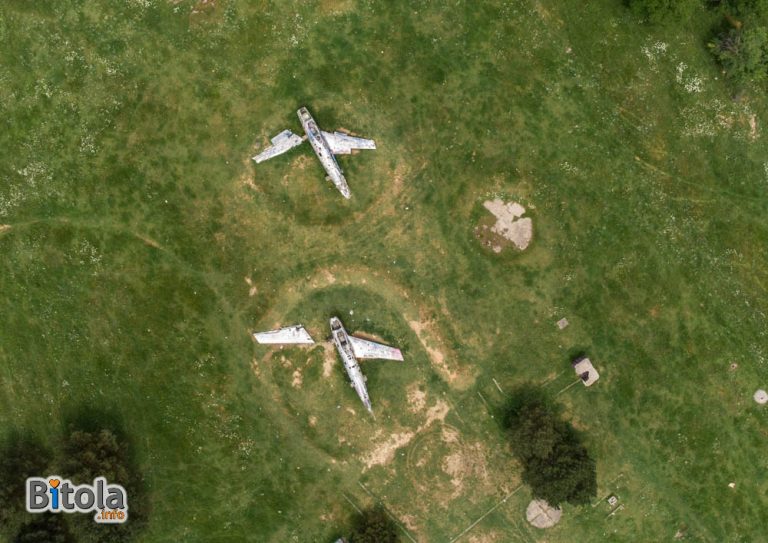
In this context, and without a clearly defined military objective, French aviation began bombing Bitola and other border towns in the newly occupied Bulgarian territories. These air raids caused massive destruction and unnecessary civilian casualties, leaving lasting damage to the urban fabric and the lives of the people.
Bitola, once a vibrant administrative and cultural center, slowly became a frontline city — exposed to dangers far beyond local causes, shaped instead by the brutal logic of a global war.
“January 23, 1916. At 9:15 in the morning, twelve French airplanes flew over Bitola and bombed the city. Five bombs fell very close to our walls, exploding in our small street. The two houses opposite ours were pierced through, all our windows shattered, and fragments of bombs tore into the chapel. There are reports of 150 killed or wounded…”
— Sister Raymond, French missionary in Bitola, from her memoirs
With the offensive launched in the summer of 1916, the frontline moved deeper into Macedonia in favor of the Entente. By November, Bitola was captured, and the Central Powers retreated to the surrounding mountains.
At that moment, a city of roughly 25–30,000 inhabitants found itself directly on the front line. Allied troops — French, Serbian, Italian, and Russian — were stationed within the city, among the civilian population.
Meanwhile, German and Bulgarian forces occupied the nearby mountains, less than 15 kilometers away. This made Bitola one of the few European cities that remained on the front line for years.
Unlike many cities in Western Europe, where civilians were evacuated in time, the people of Bitola were not systematically moved to safety. Instead, they remained trapped under constant shelling and air raids.
Civilians became unwilling hostages of the front, leading to massive collateral damage, civilian deaths, and deep psychological trauma. Bitola was no longer just a military target — it became a city where civilian life was sacrificed in the machinery of total war.
Thus began the darkest chapter in its history.
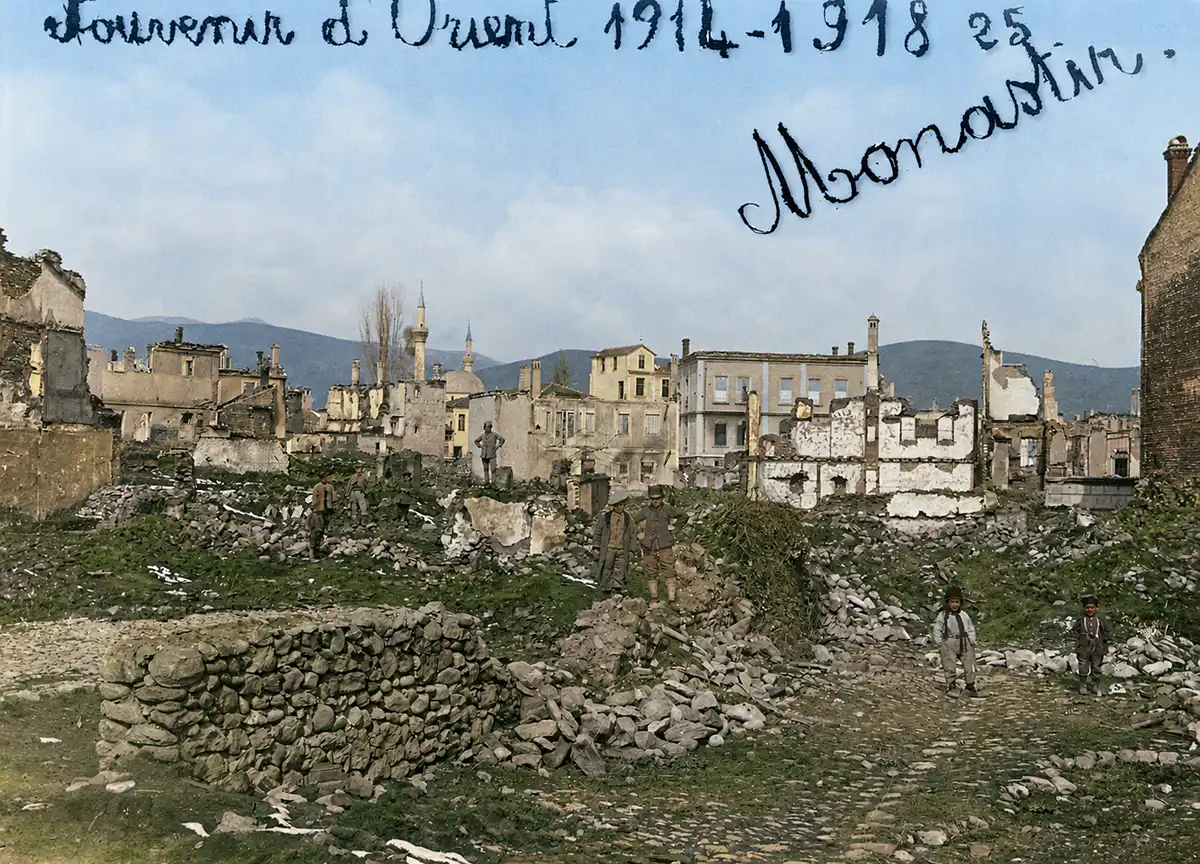
For nearly two years, Bitola endured relentless artillery and aerial bombardment, using every form of destruction available at the time — high explosives, incendiary shells, and gas. The line between military and civilian space vanished.
Food supplies dwindled, and hunger became a daily reality. People scavenged wood from ruined buildings to survive the cold, dismantling entire neighborhoods just to stay alive. Medical care was almost nonexistent, while disease continued to ravage the weakened population.
The city was bombed almost daily, even when there were no clear military targets. The front remained largely static for two years — yet the war had to continue. Shells had to be fired. Ammunition had to be spent.
Behind these projectiles stood a complex web of economic and political relations. Bulgarian peasants paid for German shells with grain. Serbia bought weapons from France with money borrowed from France — which itself was indebted to the United States. Thus, behind the visible war raged another invisible one: financial and economic.
Then, as now, money was one of the main driving forces of war. Over time, these processes reshaped global power, creating new economic and political centers whose effects would be felt for decades.
On September 15, 1918, at Dobro Pole in Mariovo, the breakthrough of the Macedonian Front began — an event many historians consider the beginning of the end of the First World War. It quickly destabilized the balance of power in the Balkans.
Soon after, Bulgaria, the Ottoman Empire, and Austria-Hungary capitulated, leading to the armistice with Germany on November 11, 1918. The war had officially ended — but the suffering of the people had not.
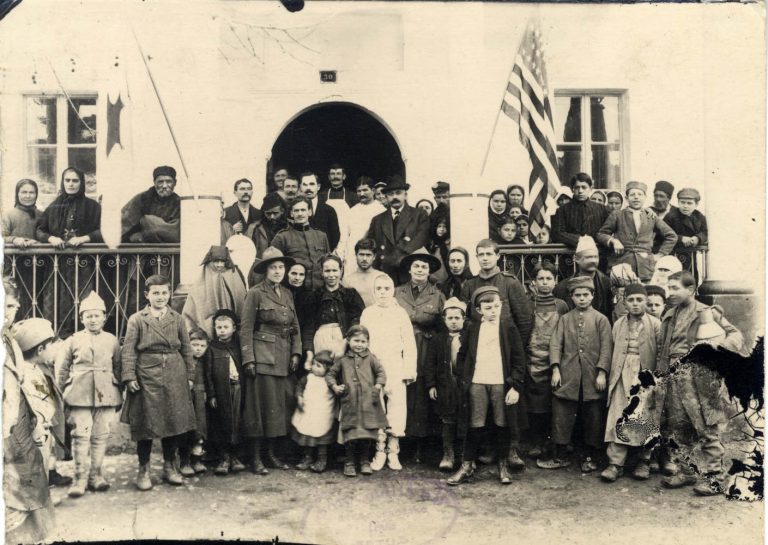
“When we arrived in Bitola, the place was an open grave. Packs of wolves and dogs roamed the hills, digging up and gnawing at shallow graves. Human remains lay scattered across the land. In the villages lived people who looked like skeletons, wrapped in rags, digging for roots to survive. Bitola was filled with orphaned children — no one knew where they came from or how they had survived. Many stood naked in the Red Cross food lines, while others were found dying in the ruins from influenza, typhus, or starvation.”
As a direct consequence of the war and massive troop movements, the Spanish Flu pandemic spread across the world. In two years, it claimed several times more lives than the war itself — between 50 and 100 million people.
In Macedonia, the exact number of victims was never determined due to a lack of reliable records and the massive displacement of people.
However, it is well known that the Kingdom of Serbia — which included Macedonia — had one of the highest mortality rates in Europe, reaching up to 27 percent according to some historians. In frontline areas like Bitola, the impact was likely even worse.
The war left entire generations marked by loss and trauma. Thousands of children became orphans, countless people were physically and mentally mutilated, carrying the scars of the front for the rest of their lives.
The land was devastated. Where fertile fields once stretched, there were now graves and ruined trenches. The lack of livestock and labor made farming nearly impossible, deepening poverty and hunger.
Bitola and its surrounding villages were largely destroyed. Houses were flattened or badly damaged, and there were neither craftsmen nor materials to rebuild them. People lived in makeshift shelters among ruins that reminded them daily of the catastrophe they had endured.
It took many years for life to return to something resembling normal. Yet the scars of war remained — etched not only into the landscape, but into the collective memory of the people.
The city became a place where front and civilian life overlapped, where daily existence was marked by danger, destruction, and suffering.
Even after the peace was signed, the war continued to claim lives through unexploded shells scattered across fields and villages around Bitola — a hidden threat long after the guns fell silent.
A painful reminder that war does not end when the fighting stops.
This story is not just about the past. It is a warning.
Bitola was not just a front — it was a home. A home to people whose lives were crushed between the interests of great powers in a war they did not choose.
Today, as we walk these same streets, we must remember: peace is not a gift. It is a choice. A responsibility. And a duty to those who paid for it with their lives.
Cities can be rebuilt. Houses can rise again.
But human lives — never.
Author of the text: Jove Pargovski, Bitola.info